
Why Diversification Still Matters
 Share on LinkedIn
 Share via Email
 Save as PDF
Conventional wisdom suggests that diversification is the only free lunch in investing, and investors have historically been encouraged to diversify both within and across asset classes. Within an asset class, holding a broad range of securities reduces the company-specific risk associated with concentrated exposure to a single stock. Across a portfolio, exposure to a variety of asset classes, such as bonds and non-U.S. equities, has traditionally provided diversification benefits and lower volatility. For example, from 2000 to 2020, a diversified 60/40 portfolio produced better returns (+229%) than a global all-equity portfolio (+182%) with less risk, as measured by volatility. 1
However, for several years leading up to 2025, if an investor owned virtually anything other than the S&P 500, they likely underperformed and sacrificed return. This was largely driven by outsized returns from a handful of large technology stocks that dominated index performance and collectively represented an average weighting of 37% in 2025.2 In fact, an investor who simply owned the seven largest technology companies in the index over the last several years would have generated returns far in excess of the broader market.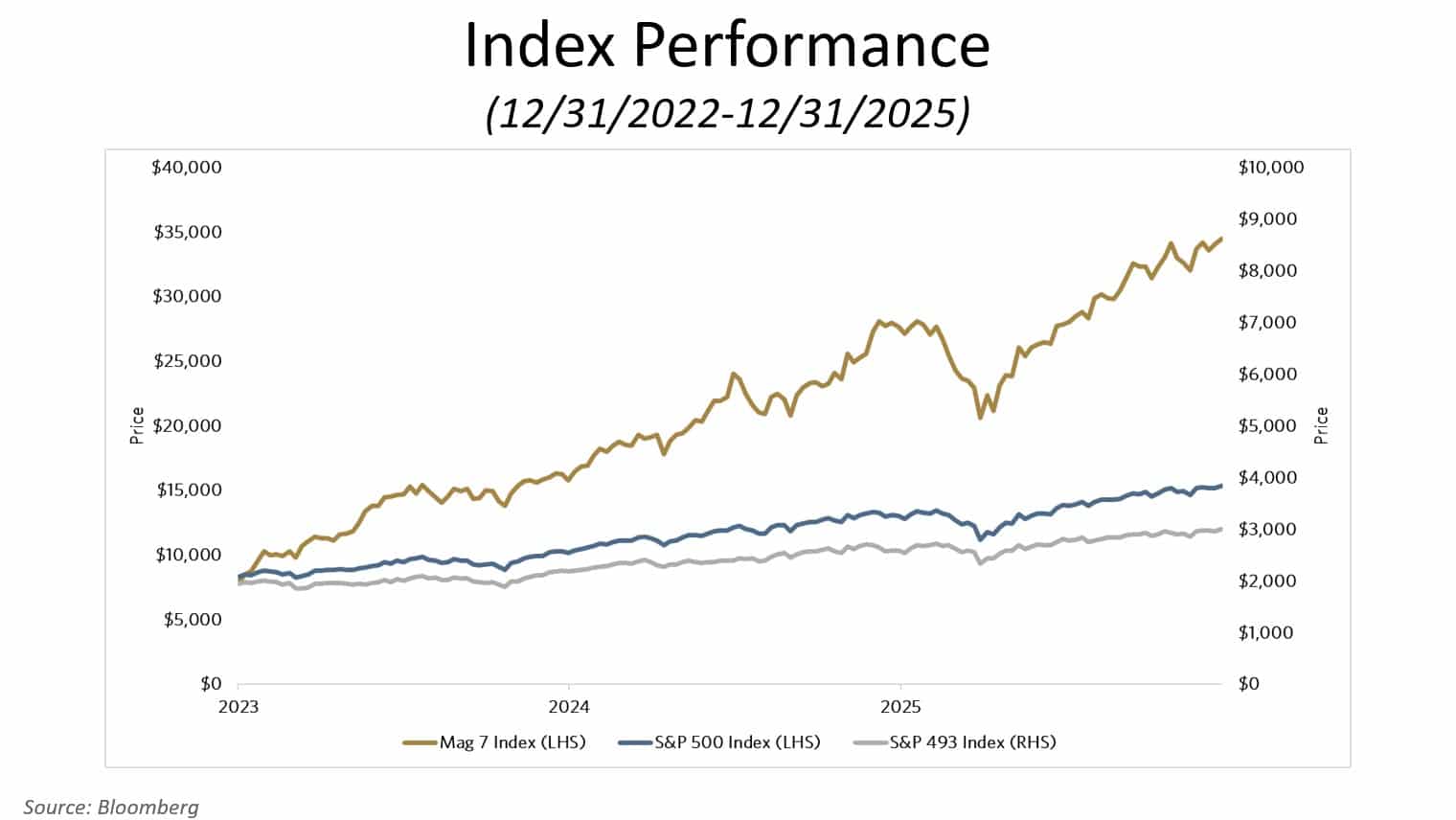
Investors in recent years have not been rewarded for diversification, and many began to wonder whether the traditional 60/40 portfolio was dead. This sentiment was reinforced in 2022, one of the worst years on record for balanced portfolios, as the Federal Reserve rapidly raised interest rates to combat inflation. Bond prices fell, yields rose, and equities corrected amid fears of an impending recession. The result was a historically challenging year for both stocks and bonds.
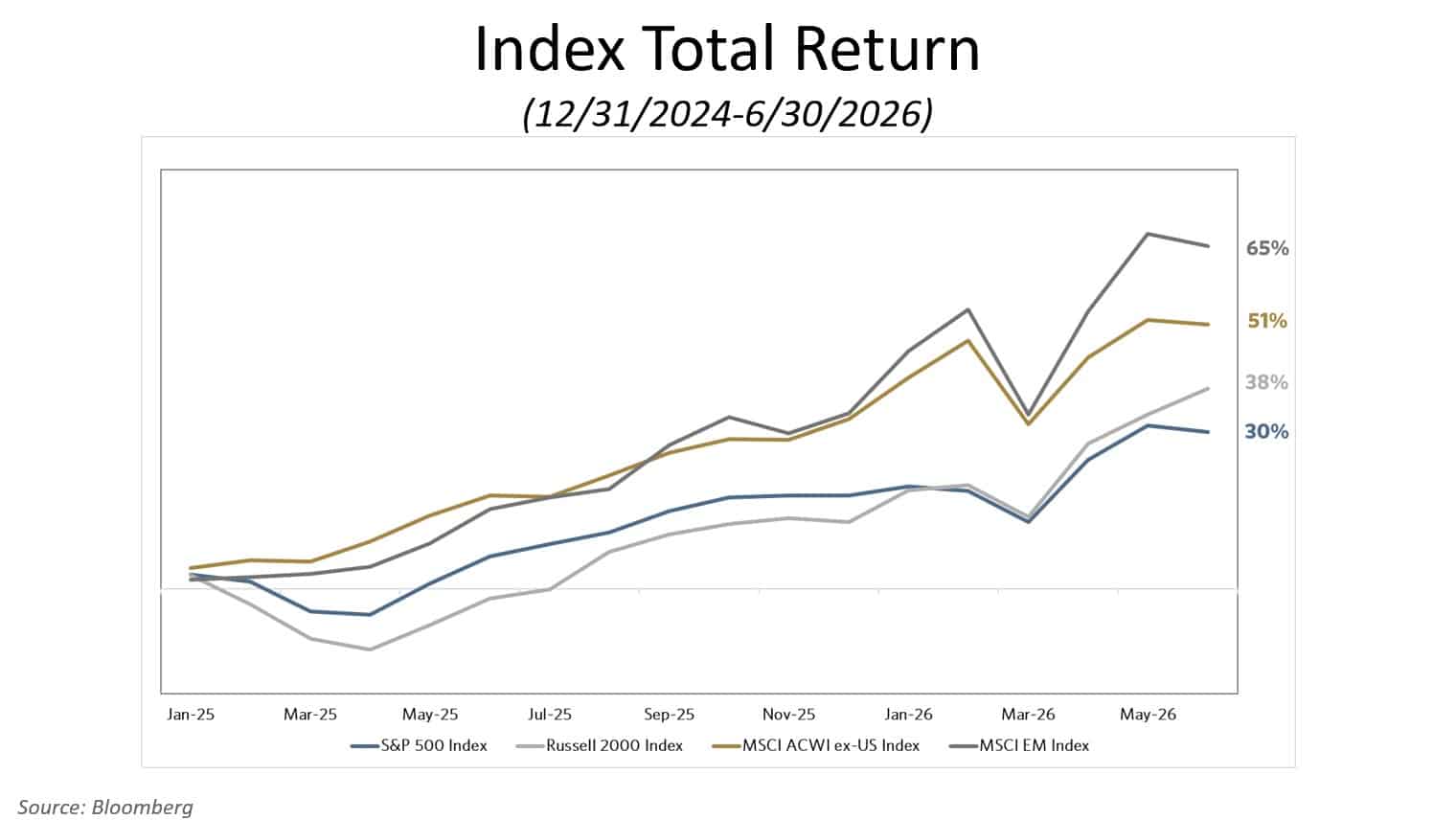
More recently, we have started to see some of the traditional benefits of a diversified portfolio again. Over the last 18 months (from 1/1/2025 to 6/30/2026), small cap stocks, non-U.S. developed stocks, and emerging market stocks have all outperformed the S&P 500. During this period, investors with exposure to these asset classes produced superior returns.
Importantly, bonds in diversified portfolios today are contributing meaningfully to overall performance in two different ways. First, with yields having normalized, a portfolio holding a combination of municipal, investment grade, and high yield bonds has the potential to generate a return on fixed income of 5.8% on a taxable-equivalent basis.3 Bonds today are doing something they have struggled to do since 2008: contribute meaningfully to portfolio total returns. Second, we have recently seen bonds perform their other important role in a portfolio: providing downside protection and reducing volatility. While it was a relatively short episode, the peak to trough drawdown in equities from January 28 to March 30 of this year saw equities fall between -7-9%.2 During that time, municipal bonds fell -1.2%, investment grade bonds fell -0.4%, and high yield bonds fell -1.3%.2 Investors in a balanced, diversified portfolio experienced a smaller drawdown and a quicker recovery, which is one of the most important reasons to include fixed income in investment portfolios.
The final important benefit of diversification relates to domestic equities and the “artificial intelligence” trade that is currently taking place. As mentioned, much of the recent market performance has been driven by large technology companies that are all competing to develop the most compelling AI products and services. This has resulted in significant capital expenditures, elevated stock prices, lofty valuations, and uncertain returns on investment. Given that these large technology companies make up such a significant percentage of the S&P 500 Index, and that they are exposed to many of the same risks (including the success of AI), we think it makes sense to own assets that are less correlated to them and exposed to different risk factors.
At Tolleson, we are focused on investing for the long term and through various market cycles. We are consistently reminded that investing is a long-term endeavor, and one of the most important decisions an investor can make is to remain invested. While portfolios evolve over time, maintaining exposure to a diverse set of asset classes and sticking with them through volatile and uncertain periods remains important. The historical benefits of diversification are well documented, and after several years of market concentration, those benefits are becoming easier to see again.
General Performance Information: The performance results in this presentation have been compiled by Tolleson Wealth Management (“TWM”). Past performance is no guarantee of future results. No representation is being made that any account will or is likely to achieve profits or losses. All investments involve risk, including the loss of principal. A client’s return will be reduced by the advisory fees and other expenses. TWM’s advisory fees are described in Part 2a of our Form ADV. This information discusses general market activity, industry or sector trends, or other broad-based economic market or political conditions and should not be construed as research or investment advice. Certain information contained herein concerning economic trends and performance is based on or derived from information provided by independent third-party sources. Opinions expressed are current opinions as of the original publication date appearing in this material only. Any opinions expressed are subject to change without notice and TWM is under no obligation to update the information contained herein. TWM disclaims responsibility for the accuracy or completeness of this report although reasonable care has been taken to assure the accuracy of the data contained herein. This material has been prepared and is distributed solely for informational purposes only and is not a solicitation or an offer to buy a security or instrument or to participate in any trading strategy. This report may not be reproduced, distributed or transmitted, in whole or part, by any means, without written permission from TWM. If you have any questions regarding this presentation, please contact your TWM representative.
Index Disclosure: The returns and volatility of the indices displayed may be materially different than the client’s account, and a client’s holdings may differ significantly from the securities that comprise the indices. The indices are disclosed to allow for comparisons to well-known and widely recognized indices and may or may not be appropriate for performance comparisons. An investor cannot invest directly in the index
Sources:
- Assumes a $10mm investment on December 1999 and includes the reinvestment of dividends. This is shown for illustrative purposes only and gross of fees. An investor cannot invest directly in an index. Global equities represented by the MSCI ACWI Index. The Moderate Growth Policy Portfolio is defined as: 27% ML 1 – 12 Yr. Muni Bond Index, 39% Russell 3000 Index, 21% MSCI ACWI ex USA Index, 5% Barclays Agg Bond Index, 5% Barclays US Corporate HY Index, and 3% Citi 1-Month Treasury Bill Index. Data via Bloomberg. Period examined from December 1999 – December 2020. ** Risk measured as annualized standard deviation of returns.
- Bloomberg L.P., 2026
- Calculated as an equal-weighted yield split amongst the Merrill Lynch 1-12 Yr. Tax-Free Municipal Bond Index, Bloomberg US Aggregate Index, and a blended benchmark of 65% Markit iBoxx USD Liquid High Yield Index and 35% Bloomberg Barclays US High Yield Municipals Index.