
Yield and the Machine: Why Fixed Income Thrives in the Age of AI
 Share on LinkedIn
 Share via Email
 Save as PDF
For the first time in roughly two decades, Treasury yields provide a sufficiently high foundation for fixed income returns to compete with long-term equity-return assumptions. Yields across many bond sectors are near their highest levels in 20 to 25 years, while the 10-year U.S. Treasury yields 5%.1 With long-term equity-return assumptions generally ranging from 8% to 10%, bonds have become increasingly competitive, even before accounting for their lower volatility, pledged collateral, and priority in the capital structure.
The historical cheapness of Treasuries matters because the risk-free rate anchors credit yields. Credit investors earn the underlying Treasury yield plus compensation for credit, liquidity, and structural risk. When Treasury rates were near zero, even reasonable spreads produced modest all-in returns. Today, those spreads sit on top of a Treasury yield near 5%, allowing investment-grade, high-yield, asset-backed securities (ABS), and private-credit strategies to approach, and sometimes exceed, long-term equity-return assumptions without requiring distressed spreads.
The Bloomberg U.S. Aggregate Bond Index yields 5.33%, while high-yield bonds offer yields above 8%.1 Municipal bonds have recently provided taxable-equivalent yields exceeding 9.50% for investors in the highest federal tax bracket. The Bloomberg U.S. ABS Index yields 5.26%, with a spread of 150 basis points and a duration of only 2.90 years.1 Investors can earn meaningful income in high-quality markets while moving closer to equity-like return assumptions through selected credit sectors.
AI Is Not a Trend; It Is a Transformation
These yields coincide with a technological investment cycle that could increase productivity, expand economic capacity, and create substantial financing needs. Estimated AI infrastructure expenditures could reach $5 trillion to $6 trillion, rivaling foundational investment cycles such as canals, railroads, consumer durables, and information technology.1
Building the infrastructure needed to power AI will draw on investment-grade bonds, asset-backed securities, municipal debt, private credit, project finance, and other fixed income markets.
AI can also strengthen companies that adopt it successfully. Automation may reduce operating costs, accelerate product development, improve inventory management, enhance fraud detection, and allow businesses to generate more output from existing labor and capital. Higher productivity can support margins, free cash flow, and debt-service capacity.
Productivity Is the Central Opportunity
AI’s most consequential economic effect may be higher productivity. When an economy produces more with the same labor and capital, businesses can expand output without a proportional increase in costs. That can support earnings while reducing inflationary pressure.
For fixed income investors, these conditions can support both income and credit fundamentals. Greater productivity can reinforce corporate cash flows and tax revenues, while lower inflation can reduce upward pressure on interest rates. Credit fundamentals could remain resilient as investors collect attractive income, with the potential for price appreciation if rates decline.
The ultimate opportunity is not merely replacing workers. It is to increase what each worker and company can accomplish. AI could enable businesses to respond to customers more quickly, allocate capital more efficiently, identify supply chain problems earlier, and expand output without generating the same degree of inflationary pressure.
Financing the AI Buildout
AI’s physical infrastructure is highly capital intensive. Data centers require land, power, networking equipment, backup generation, cooling capacity, and recurring investment in advanced hardware. Large technology companies may issue investment-grade debt to fund this infrastructure. Utilities may borrow to expand generation and transmission capacity. Municipalities and development authorities could finance electric, water, transportation, and site improvements.
Fixed income therefore offers several ways to participate in AI without relying exclusively on technology-company equity valuations. Bonds can provide contractual income, defined maturities, and structural protections while financing the infrastructure on which AI depends.
This distinction is important. Equity investors must determine which companies will capture the greatest share of AI’s eventual profits and whether current valuations already reflect those expectations. Bond investors can instead finance the underlying infrastructure and focus on each borrower’s ability to meet its contractual obligations.
The Risks Are Real, but Manageable
Investors may deploy capital faster than profitable applications emerge, and some projects will rely on optimistic assumptions about utilization, energy availability, or demand. Excess capital and weak underwriting could create losses, particularly in private markets. Workforce disruption could weaken consumer spending if AI displaces workers faster than the economy creates new employment opportunities.
These risks argue for selection, not avoidance. Investors need borrowers with sustainable cash flows, manageable leverage, adequate liquidity, durable collateral, and realistic repayment assumptions. Technology can transform the economy even if individual projects, companies, or financing structures fail.
Higher Rates Are Not the Enemy
Elevated Treasury rates have reset fixed income economics. Because credit yields combine a Treasury rate with a spread, historically cheap government bonds allow investors to earn equity-like all-in yields without requiring distressed credit conditions. High-yield bonds, certain structured-credit and private-credit strategies, and taxable-equivalent municipal yields can approach and have recently exceeded the 8% to 10% return assumptions commonly assigned to equities.
Those returns arise primarily from contractual income rather than depending entirely on earnings growth and valuation expansion. Higher rates also impose discipline. Companies must prioritize projects with credible economic returns, investors are compensated for financing them, and weaker concepts are less likely to survive simply because capital is inexpensive.
The Carry Cushion
Higher starting yields provide protection against additional rate increases. A portfolio yielding 2% with six years of duration can absorb roughly 33 basis points of rising rates over one year before price declines offset its income.1 At a 5.33% yield and six-year duration, that cushion expands to approximately 89 basis points.1
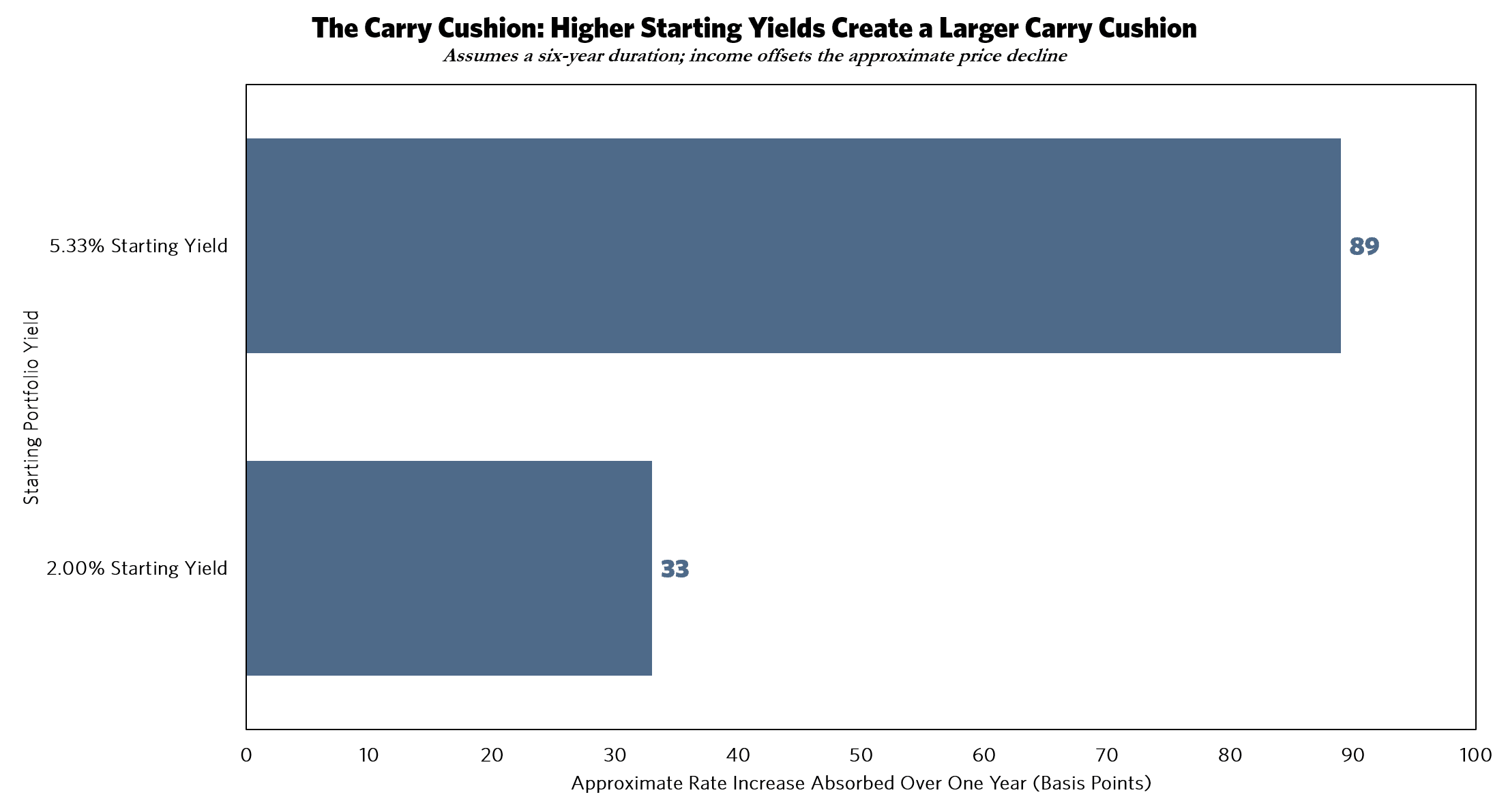
The Bloomberg Municipal 1–12 Year Blend Index, yielding 3.69% with 4.43 years of duration, has a breakeven increase of approximately 83 basis points before considering the value of its tax-exempt income.1 Carry does not eliminate interest-rate risk, but it makes that risk more manageable than at most other entry points of the 21st century.
The Role of Active Management
AI-driven change, rate volatility, and credit dispersion favor active management. Investors must distinguish essential infrastructure from speculative capacity, assess whether financing structures adequately protect creditors, and determine which utilities, municipalities, and suppliers can benefit without weakening their balance sheets.
Historically attractive yields, a generational technological transformation, and rapidly expanding financing needs have converged. The machine is changing the economy, and the bond market will finance that transformation. For disciplined investors, fixed income provides an income-oriented way to participate in AI’s growth.
Sources: 1 Bloomberg L.P., 2026
General Performance Information Disclosures: The performance results included in this presentation are actual returns which have been compiled by Tolleson Wealth Management (“TWM”). Individual investor returns may or may not be similar to the returns shown. The returns shown are based on index information and are strictly for illustrative purposes only. An investor cannot invest directly in the index shown. Investors should refer to their account statements for their actual return. Returns of this type may not show what impact material economic and market factors may have had on TWM’s decision-making at that time. Past performance is no guarantee of future results. No representation is being made that any account will or is likely to achieve profits or losses similar to those shown. All investments involve risk, including the loss of principal. These returns do not account for manager or other advisory fees that will impact a client’s overall return. A client’s return will be reduced by advisory and other expenses. TWM’s advisory fees are described in Part 2a of our Form ADV. Certain information contained herein concerning economic trends and performance is based on or derived from information provided by independent third-party sources. Opinions expressed are current opinions as of the original publication date appearing in this material only. Any opinions expressed are subject to change without notice and TWM is under no obligation to update the information contained herein. TWM disclaims responsibility for the accuracy or completeness of this report although reasonable care has been taken to assure the accuracy of the data contained herein. This material has been prepared and is distributed solely for informational purposes only and is not a solicitation or an offer to buy a security or instrument or to participate in any trading strategy. This report may not be reproduced, distributed or transmitted, in whole or part, by any means, without written permission from TWM. All portfolio and analysis herein constitute confidential and proprietary information and methodology of TWM. Disclosure of such information is prohibited. If you have any questions regarding this presentation, please contact your TWM representative.
Index Disclosure: The returns and volatility of the indices displayed may be materially different than the client’s account, and a client’s holdings may differ significantly from the securities that comprise the indices. The indices are disclosed to allow for comparisons to well-known and widely recognized indices, and may or may not be appropriate for performance comparisons. An investor cannot invest directly in the index.